

One Month Offline
An experiment in attention, rest, and the slow rebuilding of a life.

This week marks one month since I dove headfirst into digital minimalism. I’d tried before—setting app limits, deleting Instagram, making promises to myself—but I always ended up compensating somewhere else. Looking back, I think my relationship with social media started to sour during the pandemic. It was the perfect breeding ground for addiction: everyone locked inside, hungry for connection, finding in our screens the only form of social life left.
I remember the boom of online courses back then. We wanted to believe our time at home could still be productive. I definitely wasn’t the only one who bought one—or two. That new pattern of consumption fueled the rise of infoproducts and turned “experts” into influencers. For a few years, I even muted all my family and friends so I could focus on what those specialists had to say—marketers, therapists, mothers. I truly believed I was learning and evolving as a person. It took me two years to realize something was off. I felt the need to check stories constantly. I didn’t even scroll the feed anymore. The worst part was that most of those stories were endless Q&A boxes—twenty, thirty posts a day, each—and I honestly thought missing one meant losing something important. Now it makes me laugh. No one would ever share truly valuable wisdom through a channel that disappears in 24 hours.
Over time, I started to notice the cost of it all. I was spending hours on my phone, isolating myself from the people around me, running late to things that mattered. And I felt stuck. First, because I was consuming so much information that I couldn’t act on any of it. I’d gone from author of my own life to spectator. Second, content creators recycle the same surface-level ideas endlessly, saving the real substance for whatever course they’re selling next. You consume and consume, but never move forward.
Failed Attempts to Disconnect
My first Instagram fast happened during Lent in 2022. It was good for me—but not enough. I just replaced one addiction with another. I started binging YouTube podcasts, convincing myself that it was different because it was “long-form” and “educational.” The truth is, I was fully conditioned. I couldn’t do anything without stimulation. Cleaning the house meant podcasts. Grocery shopping meant music. I was addicted to noise and mistaking it for learning.
Since then, I’d tried a few more times to cut back, always unsuccessfully. I even read Cal Newport’s Digital Minimalism, but wanted to apply the ideas without the detox. I learned that’s impossible. To relearn intentional digital use, the detox isn’t optional—it’s essential.
A Real Detox Begins
So on September 23rd, I joined a challenge with a few friends that included eliminating one bad habit. I knew exactly which one had to go: social media. I already knew it wasn’t good for me; I just didn’t know how to leave it behind. My biggest excuse was distance. My family lives in Brazil, and Instagram had always been how I shared my son’s growth with them. It was a valid reason—but not enough. I had to admit it: sacrificing my mental health just so others could see pictures of my life wasn’t worth it. I would need to find another way to stay in touch.
One of the first things I did was install an app that makes the iPhone interface intentionally plain—it’s called Minimizit. It removes all the icons, leaving only the essentials. I kept phone, messages, maps, and camera. Then I deleted every app I didn’t truly need. Goodbye Instagram, TikTok, WhatsApp, YouTube. I also bought a phone case that looks like a wallet, and strangely, that helped a lot. Phones were made to be used outside the home, not carried everywhere like oxygen. Keeping it closed, tucked away, made it less tempting.
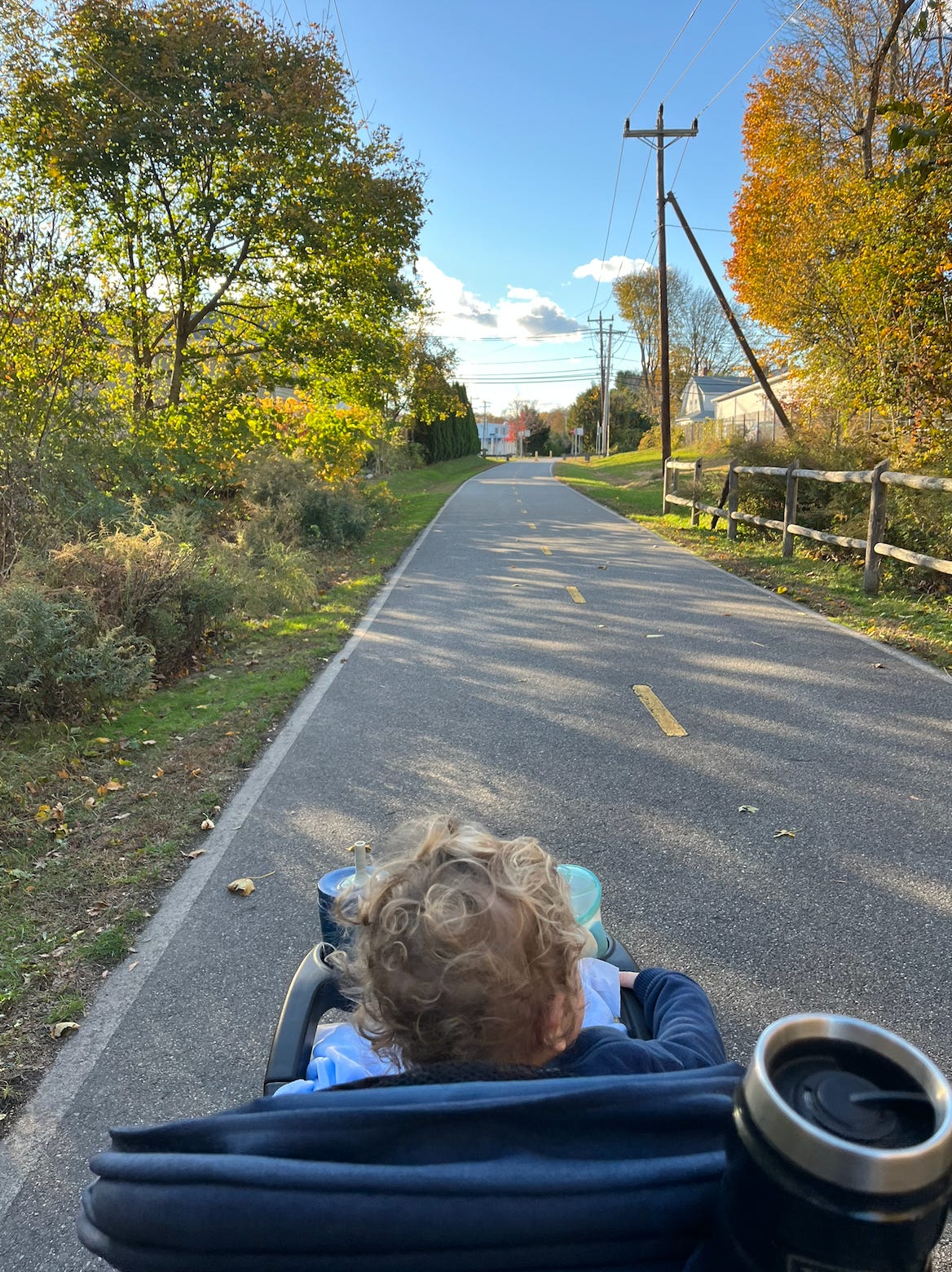
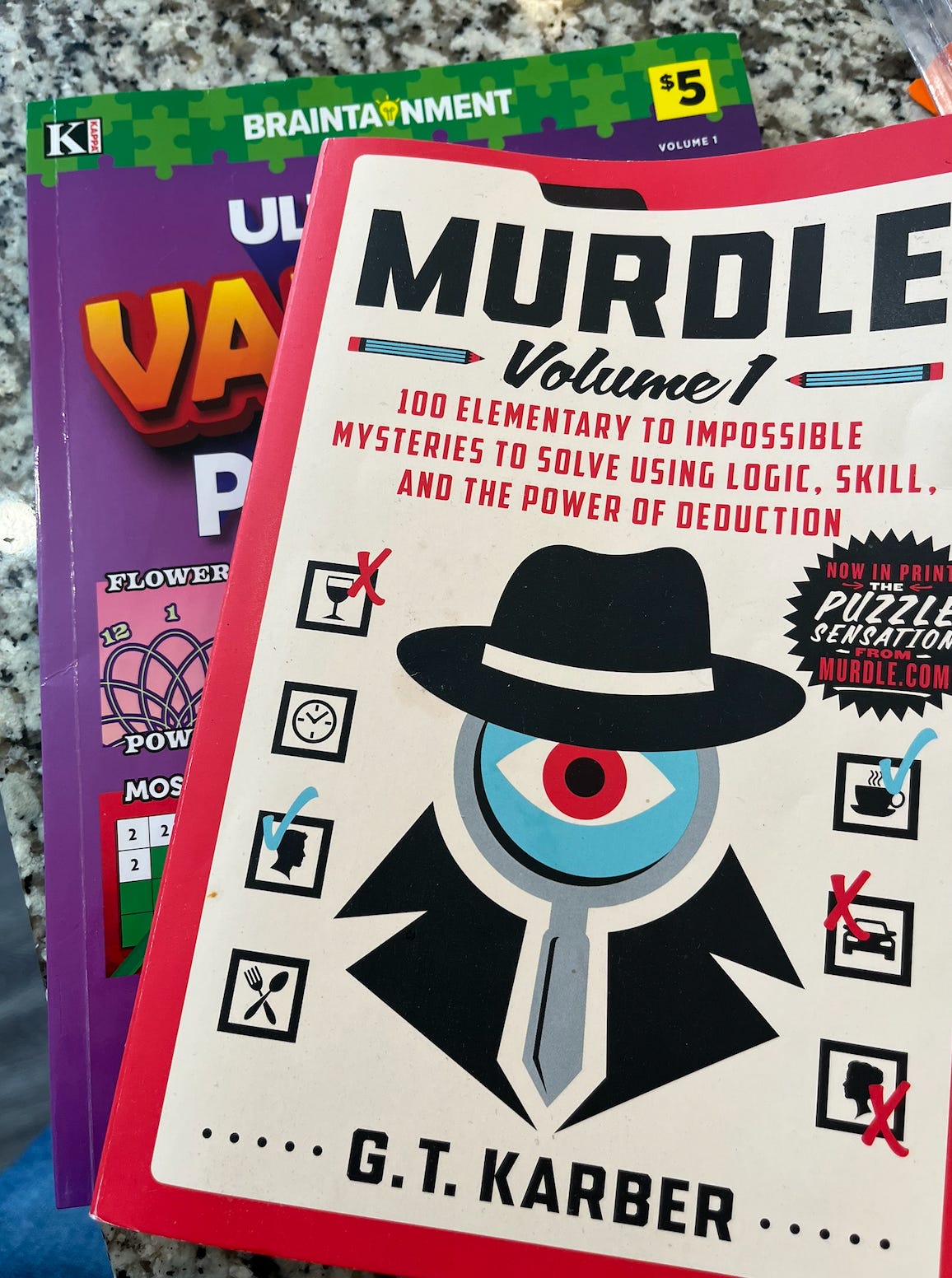
That first weekend, I swear I didn’t know what to do. I felt a strange kind of emptiness. Since I’d decided to use my computer only for work, I really had nothing to fall back on. So I got my son ready, put him in the stroller, and walked to the Dollar General a few blocks away. I bought crossword puzzle books, a journal, and some pens. That Saturday night, after putting our son to bed, my husband and I ordered pizza and sat in the living room doing crosswords together. It’s hard to explain what I felt. Our “normal” had been each of us on our own phone, side by side but worlds apart. That night we were playing, laughing, thinking. It was simple—and it felt alive.
The First Fruits of a Screenless Life
In the following weeks, I began to notice the first fruits of a life without constant screens. The first was sleep. For years, I’d gone to bed exhausted but unable to fall asleep. Bored, I’d reach for my phone and scroll until I passed out with it under my pillow. No matter how long I slept, I woke up tired. Now I understand why: blue light suppresses melatonin, the hormone that helps us fall and stay asleep. But it wasn’t just the light—it was the constant stimulation. My brain had forgotten how to rest. Only when I returned to analog forms of leisure did I realize I hadn’t truly rested in years. I once believed that lying on the couch scrolling through my feed was rest. Now I laugh at that thought. Nothing drains you faster than a phone.
If you don’t believe me, try spending a Sunday completely offline. Turn off your phone, Netflix, anything with an infinite feed or recommendation loop. Take a walk. Explore a part of your city you’ve never seen. Go to a restaurant without reading reviews first. Sit on your porch and read a chapter of that book you’ve been ignoring. Then tell me how you feel on Monday morning.
From Detox to Lifestyle
By the end of the first week, I felt so good that I knew this couldn’t just be a detox—it had to become a lifestyle. I decided to use my computer only during work hours and installed a Chrome extension called FocusGuard to block sites like YouTube. WhatsApp, which I use for work, stayed on the computer too. That created a clear boundary: if someone messaged me outside of work, they’d simply have to wait. The first checkmark appears, but the second one—delivery—only shows up the next day when I open my laptop again.
What surprised me most was realizing how little time my work actually required when I wasn’t distracted. Tasks that once felt endless took minutes. When you stop responding to every ping and notification, everything flows. Now I open my computer and start with the most important task of the day; only afterward do I check messages or emails. They’re the silent enemies of productivity. Last month I read The One Thing, and it taught me the value of doing what matters most before the world has a chance to interrupt.
Tools for a Calmer Mind
Outside work hours, if I need to look something up, I use my Echo Show in the kitchen. The browsing experience is terrible—which is perfect. I search what I need and move on. Over time, I began to feel a real desire to create again, to write for my Substack and help others detox from the digital chaos. That’s when I bought my first intentional device: the Boox Go 10.3.
I’ve never liked the idea of replacing my smartphone with a “dumbphone.” My iPhone still works fine, and in an emergency, it could save me. Considering my daily screen time now averages fifteen minutes—usually just a call from my husband on his way home—the idea of keeping my phone stored in a fixed place works beautifully. I don’t carry it around the house, and with no entertainment apps, there’s nothing to tempt me. No need to spend another seven hundred dollars on a Light Phone; I simply repurposed what I already owned.
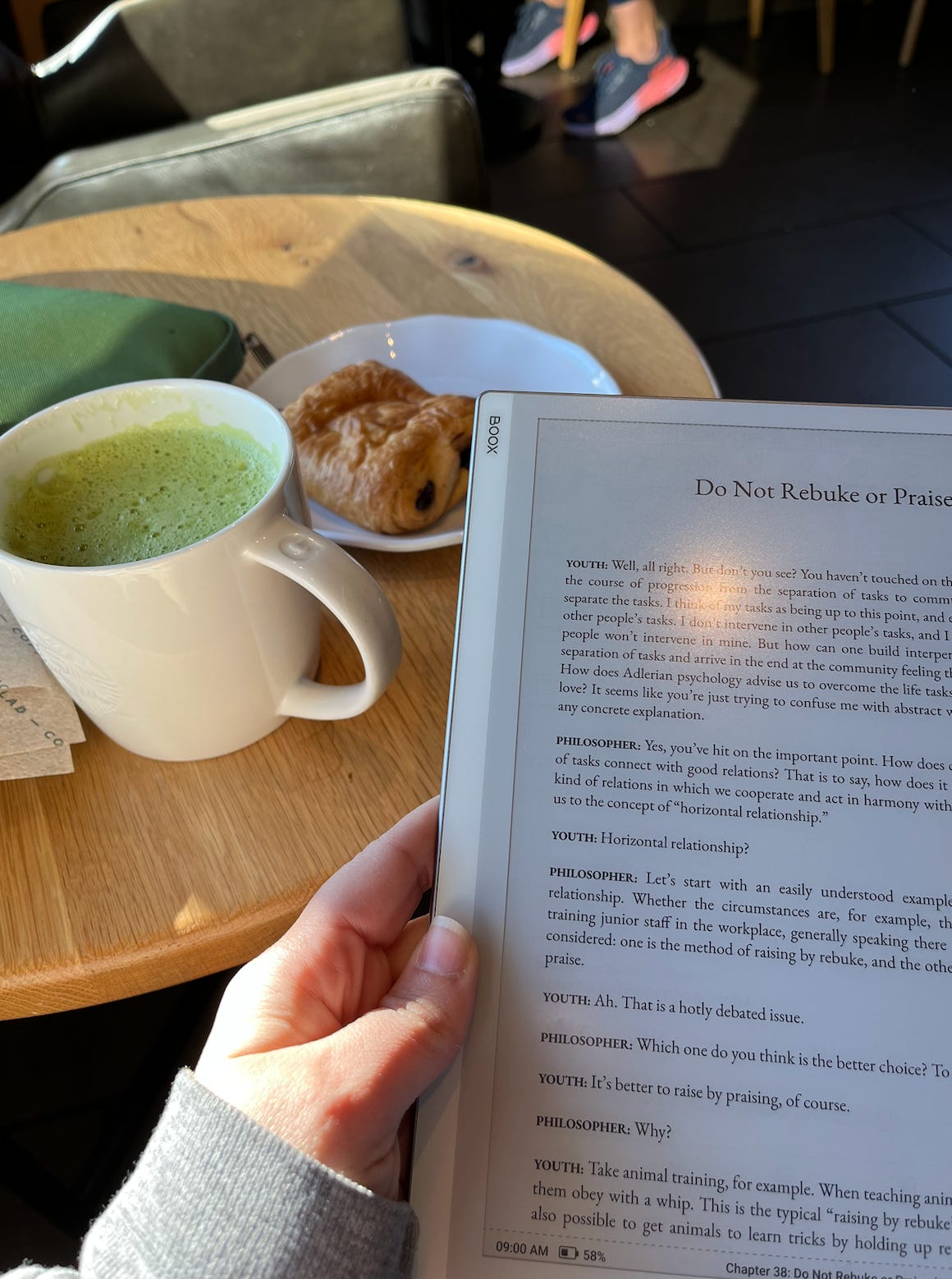
The Boox, however, filled an important gap in this new lifestyle. I chose an e-paper device precisely because it has no colors and no light. The lack of color keeps it from triggering dopamine spikes, and the absence of light protects my eyes and my sleep. It lets me live closer to my natural rhythm. In black and white, the real world feels vibrant again.
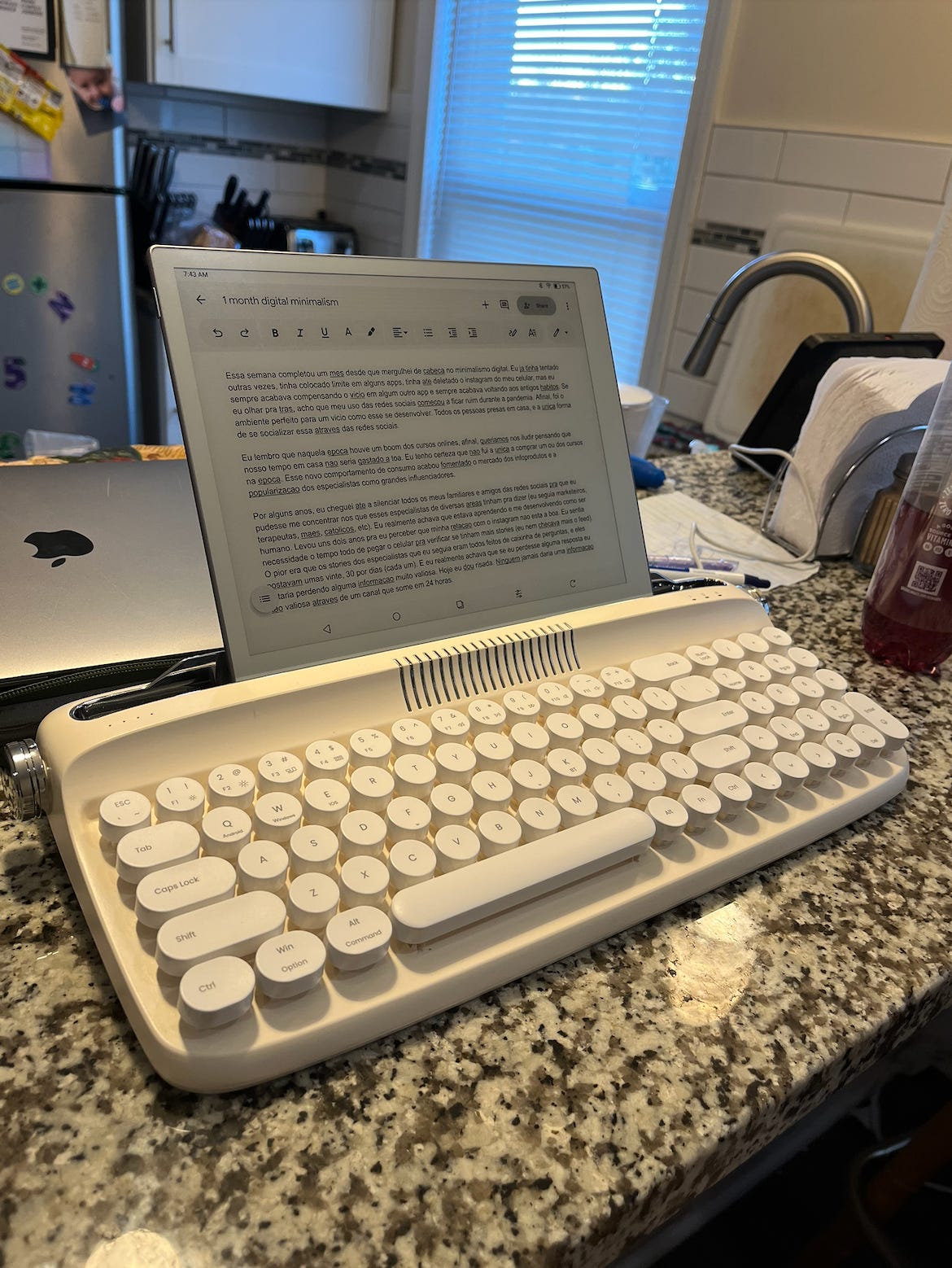
With the Boox came a keyboard. My mornings now begin with the quiet rhythm of typing. After my son wakes up and we have breakfast, I sit for a few minutes and read from the newsletters I save in Readwise Reader (I wrote about it here). I love that I can collect everything I truly want to read without opening my inbox or facing any algorithm. It’s a curated, deliberate kind of digital consumption. And I knew the device wasn’t addictive when my almost-two-year-old saw me using it and didn’t even try to grab it.
A Quieter, Fuller Life
In the past few weeks, I’ve lived moments with my family that were ordinary yet deeply joyful. Taking my son to the playground while listening to the radio—his first time hearing radio—and feeling the small wonder of every unexpected song. Cooking together without stress. I used to get irritated because I wanted to be on my phone; now, presence is no longer scarce in this house. At night, instead of sitting side by side behind separate screens, my husband and I talk, laugh, and just exist. And the most precious thing of all: a peace, a quiet in my mind I never thought possible. No day can be ruined anymore by something I saw online. I’m shielded now—finally, fully alive.
Maybe this is what recovery from the digital age looks like: not a grand revelation, but a quiet return. A return to mornings that begin without noise, to meals that aren’t photographed, to thoughts that don’t need to be shared to exist. It’s the slow rebuilding of attention, of presence, of self. A month ago, I thought I was quitting social media. Now I see I was simply coming home.